
Last week, I was honored with an award from the women’s running group that 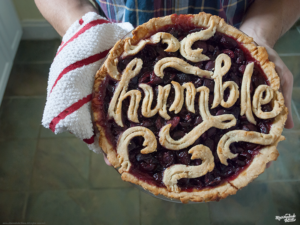 I’m part of and my immediate reaction was, “I don’t deserve that.”
There is a pattern in my thoughts, and maybe yours too, one that says:
“I don’t deserve to have that chocolate cake because I didn’t run today.”
“I don’t deserve to get that promotion at work because what I do is not technical.”
“I don’t deserve to live in my dream house because I’ve made bad choices in the past.”
“I don’t deserve to have fun and be proud of my running because I’m not fast.”
This all made me realize that I need to eat my humble pie. Not in the usual way that expression is used but rather in a metaphorical way, where my pie is made of an excess of humility to the point of making my world view that of being a person of lesser status.
You see the pattern, the one that says – I’m not enough, I’m not worthy, I’m less than – it gets in the way. It blocks the things I desire from entering my life.
This pattern is one that I’ve been trying to turn on its head by changing my thoughts to:
I deserve.
I deserve that chocolate cake.
I deserve that new blouse.
I deserve the gift from a friend.
I deserve that recognition at work.
How might my life be different if I faced my day by recognizing my innate worth? As Maria Shriver says in her essay, I’ve Learned that I Deserve, “It’s not selfish or arrogant. It’s a way to be kind and loving to yourself.”
If I started there – feeling empowered by all that is good – I might more easily fulfill my needs and those of others.
Will I get everything I want and need? Indeed not. Life will still throw injustices and hard times my way as it does to everyone else, but I’ll face it all – the good and the bad – with the strength and power of my worth – because I deserve to give and receive love and all the gifts of the universe.
So please excuse me while I munch on my humility.

 A client named, Colleen, came to my office a few weeks ago feeling out of sorts. When I asked her what she was seeking, she said, “balance.” Ah, yes, indeed, Reiki is an excellent modality for helping one achieve balance and clients often are seeking it.
 adjustments in order to achieve a balanced posed. Getting to a place of balance means being un-balanced at times. Balance is achieved after we have swayed and stumbled.

 So, you’re a sensitive person. Some people may call you highly empathic. You feel things, you notice things, you know when something is not right and someone is out of balance. It’s not an intellectual knowing — it’s on an intuitive level that you sense these things. It may be hard to describe how you receive this information, but without a doubt your intuition / your radar is highly attuned to others and the world around you.
 Last month, I completed my second half marathon. It was a different challenge for several reasons. Some were known ahead of time; some were not.